.
Excerpt from a discussion with His Divine Grace A.C. Bhaktivedanta Swami Prabhupada
Founder-Acarya of the International Society for Krishna Consciousness
____________________________________________________________________
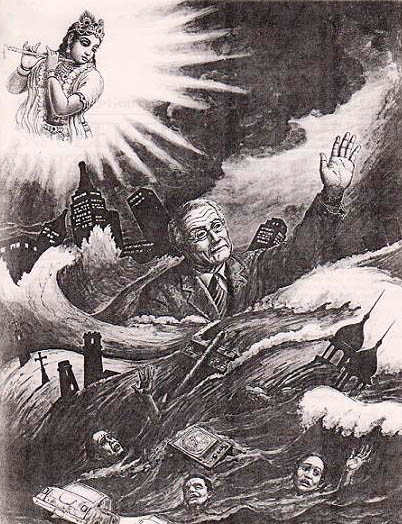
Swiss psychologist Carl Jung sought a way out of the ocean of material suffering. Yet he felt, "I had to make do with my own truth..." (An informal discussion with His Divine Grace A.C. Bhaktivedanta Swami Prabhupada and some of his disciples on the subject of Carl Jung's esoteric philosophy.)
Syamasundara: There is also another psychologist, Carl Jung, he's also very important. He followed Freud.
Revatinandana: To some extent.
Syamasundara: I mean chronologically. Freud's idea was that unconscious processes are invariably infantile, animal, or pathological. Jung said that some unconscious energies are sources of positive and creative activity. That the unconscious is important for the growth and development of the mature and well-adjusted personality. Freud investigated the unconscious and found that the negative side, that our unconscious life is always threatening us, that it is the cause of pathological...
Prabhupada: What do you mean by unconscious life?
Syamasundara: Subconscious, that which we are not consciously aware of...
Prabhupada: That means it is consciousness but it is covered.
Syamasundara: Yes. He says that unconscious part of our mind is dangerous, infantile, animalistic. But Jung says that the unconscious can also be positive and helpful to the growth of our personality, that it can be an asset to understand this unconscious life.
Prabhupada: But I think that the subconscious status as it is covered by the present consciousness, similarly, it can be covered by Krsna consciousness, so that those subconscious states will be no longer able to react.
Syamasundara: He sees a positive or creative function of this unconscious...
Prabhupada: Just like the other day I was citing the sloka of Yamunacarya about sex life. The subconscious status is there, sex life, but because he has got Krsna consciousness, he is spiting on it. That means the subconscious state cannot overcome. So our policy is that you become fully Krsna conscious, and then all the subconscious status which is gathered for life after life, and they are stored, they are in stock, they will not be able to overcome.
Syamasundara: He sees that the mind is composed of a balance of conscious and unconscious, just like light and dark, there's an equal amount, but that the function of the personality is to integrate the conscious and unconscious functions. For instance, if one had a strong sex desire, if somehow he were able to cultivate or channel that into a creative art or a creative value. Just like this brahmacarya, that sex impulse is channelled into higher thinking about Krsna.
Prabhupada: That is our process. Just like sex impulse is natural for everyone in the material (world), but if we think of Krsna embracing Radharani or dancing with the gopis, then our sex impulse becomes subordinate, no more stronger. Hrd-rogam kamam asv apahinoti. Hrd-rogam kamam, this is a heart disease, to be lusty. But if anyone hears about the pastimes of Krsna and the gopis, through right source, then this hrd-rogam, this lusty desire in the heart, is suppressed and he will develop devotional service.
Syamasundara: This is an example of what Jung would call individuation, where the energies of the unconscious sex impulse are channelled into a conscious and creative activity of God realization. So those energies are being utilized in a proper way. This is what he would call integration or individuation.
Prabhupada: This thing I was explaining, this prakrti, it is very scientific. Krsna is the only purusa, enjoyer and if every one of us serves everything in the propensity of His enjoyment, that is our enjoyment. That is our enjoyment-predominated and predominator. Just like, crude example, it is not exact: husband wants to enjoy wife, and the wife voluntarily helps him in that enjoyment, the wife also becomes joyful. Similarly, the supreme enjoyer is Krsna, and if you help Him in His enjoyment, then automatically we become also joyous. Predominated enjoyer and predominator enjoyer. Both of them enjoying but one of them is predominated, one of them is predominator. So predominated, when... He helps to be predominator, reciprocation of enjoyment.
Revatinandana: Srila Prabhupada, there's one point, I think if I understand it, you will say that from the man or a woman being you can see the (indistinct) sex desire is there, from the body comes sex desire. He says then that sex desire can be elevated for self-realization or for some kind of higher...
Prabhupada: No, no.
Revatinandana: No, but for some kind of higher pursuit, that same sex energy can be channelled at what you would call a higher (indistinct).
Devotee: Sublimation.
Revatinandana: But we say that originally there were desires to enjoy coming from the soul. If it is channelled to the body it becomes sex lust, but if it is channelled higher it becomes higher (indistinct) for advancement. It's not coming from sex, it's coming from the soul, is that correct -- the desire to enjoy?
Prabhupada: No. Try to understand. Sex desire is there in everyone. So once sex desire is (indistinct) up, male sex desire and female sex desire. The sex desire is there in both male and female, but some from impartial view, it appears that the male is the enjoyer and the female is the enjoyed. So both of them are (indistinct). So the female, if she agrees to be predominated, enjoyed, then naturally she also becomes enjoyer. So living entities are described as prakrti, female. So when the living entities agree to help Krsna's sex desire, then they become happy.
Devotee (2): But it's not by Krsna's sex desire. What is the meaning of the words "Krsna's sex desire"? Krsna's satisfaction?
Prabhupada: Yes. Sense enjoyment, you can say. Sensual enjoyment. Krsna is the supreme proprietor of the senses. So when we help Krsna for His sense enjoyment, then naturally we also (indistinct). Same example, just like a rasagulla (a tasty Indian sweet). A rasagulla is to be enjoyed. So the hand takes it and puts it into the stomach. The hand does not enjoy it directly. And when it is put into the stomach, the hand also enjoys, the stomach enjoys, the eyes enjoys -- everything. The direct enjoyer is Krsna, and all others, indirect enjoyer. By satisfaction of Krsna, others will be satisfied. Not directly. Just like a beloved wife, when she sees the husband is eating nicely and he is enjoying nicely, she becomes happy. She becomes happy. So there are two different categories: the predominated category and the predominator category. So by seeing the predominated happy, the predominator becomes happy. That is (indistinct).
Syamasundara: So in one sense you could say that the conscious mind is the predominator and the unconscious...
Prabhupada: Both of them are conscious, predominated and predominator. Both of them are conscious. Without consciousness there is no life.
Syamasundara: But in the individual personality if there is an unconscious and a consciousness, then the unconsciousness, or the unconscious state, should be predominated by the conscious state. The conscious state...
Prabhupada: That is practically being done. Unconscious or subconscious states sometimes come out. They are not always present. But consciousness is always there.
Syamasundara: But if the consciousness is not the predominator, then sometimes a person's activities will be irrational or unconscious.
Prabhupada: No. There is no question of unconscious. Subconscious, that is there. Yes.
Devotee (3): What is the exact meaning of the term "subconscious"?
Prabhupada: Mm? Consciousness?
Devotee (3): I understand the principle of consciousness, but what is the exact meaning of the word "subconscious"?
Prabhupada: Subconscious means is not acting at the present moment but it comes out sometimes.
Syamasundara: These psychologists say that quite often the unconscious is acting through the conscious, only we don't know.
Prabhupada: Yes. That I say. The subconsciousness is there, but they are not manifest. But sometimes they are manifest. All of a sudden coming. There is no connection. Just like a bubble in the pond. All of a sudden a bubble comes up. You see. So the coming out of the bubble, the energy was there within, all of a sudden it comes out, "Pop!" Yes. And even you trace out why it came, but the, it is to be supposed that it was in the subconscious state; all of a sudden it has manifested.
Devotee (3): The bubble coming up is a sort of a proof that there is a subconscious which is holding that bubble and then it's released it, but where it's parted by these psychologists is that the subconscious nature is moving subconsciously. What it means is that we're not conscious of it; it's acting in a subconscious plane.
Syamasundara: Called a shadow.
Devotee (3): And so our consciousness can be modified by our subconsciousness without our being consciously aware of it.
Prabhupada: Not necessarily.
Devotee (3): That is the idea.
Prabhupada: Not necessarily.
Devotee (3): We're unconscious of the activities of...
Prabhupada: Or sometimes subconscious state manifests which has no connection with my present consciousness.
Revatinandana: Can we say that those subconscious states which sometimes reveal themselves are like stored in impressions in the mind?
Prabhupada: That is stored impression.
Revatinandana: (indistinct) potentially manifest...
Prabhupada: Yes.
Revatinandana: They are potentially manifest, but they don't have to. But they...
Prabhupada: It is just like photograph. If you take so many snap, but not all of them immediately moves.
Revatinandana: So they would posit that there's a mental functioning going on, a thinking functioning going on that we're not conscious of. I think we don't agree with that. Is that correct? We say that there's one mind, sometimes mental impressions come that are stored...
Prabhupada: Yes.
Revatinandana: ...but in that storage area of the consciousness, there is no thinking going on there. Is that correct? The unconsciousness mind is not thinking like the conscious mind.
Prabhupada: No, no. But the impression is there.
Revatinandana: Yes.
Prabhupada: All of a sudden it comes out.
Syamasundara: So Jung says that there are two types of unconscious process. The first...
Prabhupada: Why does he say unconscious?
Syamasundara: Two types of unconscious process.
Revatinandana: No. Subconscious.
Prabhupada: Subconscious, that is the right term. Why does he say? Even in psychology they call "subconscious," why he's speaking "unconscious"?
Syamasundara: The German word is unbewust, which means "unbeknown," so we have translated "unconscious," but it means more like "subconscious."
Prabhupada: Unconsciousness, of course there is, that is not (indistinct) the same thing. That is not manifest. Unconsciousness, but it will manifest.
Syamasundara: He says that there are two kinds of subconscious state. The first one is the personal unconscious, or those personal items which are highly individual from one's previous childhood, from his infantile history, certain things occurred, they were repressed, and so on. These are stored in our own unconscious state and they are aroused into consciousness in dreams and through psychoanalysis. But he also posits another type of unconscious, or subconscious, state called the collective unconscious. He says that evolution has predetermined the human brain to react in terms of basic principles derived from the experience of many generations. In other words, that my ancestors had left impressions in my brain from the time of my birth, how to react according to their experiences. Is this true, that there is a collective experience which is passed on?
Prabhupada: Yes. That experience we say parampara. Evam parampara-praptam [Bg. 4.2]. That is cultivated.
Revatinandana: He would be more..., he would say there is a German mentality, Russian mentality, English mentality, (indistinct) cultural.
Syamasundara: No, no, no. He says that these archetypal tendencies are tendencies to react in a certain manner originating from the remote past, which are true for all humans whether they are primitive savages or whether they are modern men. Just like, well, any tendency...
Prabhupada: We don't take any experience from the primitive savages. That is not parampara. Savages cannot give us any advice or instruction.
Syamasundara: Just like when we investigate different folklores, different mythologies all over the world, we find certain symbols which are the same. For instance the swastika, we find that in the Indian mythology and you find it in Maya or Inca, western Indians' mythologies as well. And different symbols which are common to man all over the globe, whether they are primitive or whether they are advanced, he says that these are archetypal images which for thousands of generations have been passed on in men's consciousness. So that we are composed not only of our own individual thoughts and ingredients but also the ingredients of our ancestors. Is this a fact?
Prabhupada: Yes. That is called tradition. That is called tradition. But that is not parampara. Parampara is different. Parampara means we get the right knowledge from the supreme. It is not something ac..., what is called? What he is speaking?
Syamasundara: Acquired. Archetypal. Means the original type.
Prabhupada: My acquired knowledge can be changed by understanding from superior. Just like generally we have got bodily concept of life, but Krsna says, "No. You are not this body." So this knowledge is not coming to me from tradition, but I learn it from great authorities like Krsna.
Syamasundara: But he would, for instance, say that our means..., aware of understanding Krsna as a supreme father, as our cause and so on, is an archetypal tendency that is shared by all human entities, that they have the same tendency to react in that way, to understand someone as their father or as their cause. And they will represent Him in different ways but always..., always similar.
Prabhupada: Yes. We see that. Exactly similar. Rather, this father is (indistinct). Krsna, or God, is the supreme father. It is similar. As father has many sons, similarly Krsna has many sons. You can say it is similar. As sons are born, children are born of father, similarly, we are born of Krsna. It is similar.
Syamasundara: For instance, in the dream life, our dream life, in the dream life of savages or anyone else on this planet, certain common occurrences take place in the dream. Sometimes we feel we are flying in dreams, or sometimes we feel that there's a disruption coming from below, or certain symbols are there, common to all men. He calls these archetypes or the collective unconscious. All human beings share these propensities.
Nara-narayana: Universally one.
Prabhupada: Mm. We have no objection in that way.
Revatinandana: Srila Prabhupada, is it possible, or is it confirmed that the similarities in symbolism and cultural relationships, which are similar in civilizations all over the world, can that be due to the fact that they are all coming from the same source? Five thousand years ago there was one culture?
Prabhupada: Yes.
Revatinandana: So you find the same symbols in the South American Incas as we find in India as we find in the Pacific Islands because they are coming down from the original Vedic culture in different states of...
Prabhupada: Vedic culture or non-Vedic culture, there are so many similarities. It doesn't matter. Because you are living being, the similarities are there. Just like every living being eats. It is similar to everyone. Every living being sleeps. It is similar to everyone. Every living being mates. It is similar to everyone. Every living being fears. So you have to take the greatest common factor. There are so many similarities.
Syamasundara: He would say also that every human being may draw a circle to represent something which is whole and complete.
Prabhupada: That is religion. These four principles are similar to every living entity. But when you come to the human platform, there is religion. That is not in the animal. That is the distinctive function of the human being. So if human being (is) without any religious principles, he is similar to animal. Dharmena hina pasubhih samanah. Therefore in every group of civilized human society, there is some sort of religion. It may be Hindu religion, Christian religion, Buddhist religion, but tendency is to accept some religion. And religion means understanding of God and our relationship with Him. So the modern civilization, according to Darwin's theory, they are advancing to become animal. That's it. Therefore they are claiming their forefathers are coming from monkeys. That somebody said on the other day, Vivekananda was asked that "Why your Indian forefathers did not come, long years ago?" He answered, "Because your forefathers were jumping in the tree." (laughter) It is very nice answer. "Our forefathers did not come because your forefathers were jumping in the tree."
Syamasundara: So this investigation by Jung opened up a new kind of universality in philosophy because it was seen that the same symbols are common to all men, of all religions.
Prabhupada: As soon as you come to the platform of human being, there is one similarity: religion. It may be under different name. Even in the aborigines, there is religion. Just like Red Indian, they have a religion.
Syamasundara: Yes. And they have the same symbols, many of them.
Prabhupada: Whatever it may be, that is a common concept. To accept some type of religion, this is common. Now, that type of religion may be different from me, but the principle is there. Just like eating principle is there, sleeping principle is there; similarly religious principle is there.
Syamasundara: And he said that each culture, or civilization, religion, they have the same understanding of the duality of existence, that there's an equal amount of dark, an equal amount of light, which he calls the yin and yang aspect or the anima and animus aspect. Under different names the same understanding is there in all religions.
Prabhupada: Is that equality, darkness?
Syamasundara: Darkness and lightness -- the duality of nature. Unconscious and conscious, he calls; these two things. He says that everyone has..., understands these are equal, balanced, these two stages, states of existence.
Prabhupada: Not necessarily equal. Sometimes it may be imbalance. One side may be heavier than the other.
Syamasundara: Yes. Actually he says that most personalities are imbalanced and that the goal of life is to become balanced, or integrated.
Prabhupada: Yes. Hmm.
Syamasundara: So he says that not only individual analysis and dream interpretation are there, but also we must examine folklore, myth, religions, symbolisms and all these, to get a better psychological insight into the unconscious process.
Prabhupada: So better psychology is that first of all human being or lower than human being. Lower than human being, they have got four principles -- eating, sleeping, mating, and fearing -- and human being extra, religion. Now which religion is higher, that you have to study. So that answer is given in the Srimad-Bhagavatam: the religious system which develops towards loving God, that is first class.
Syamasundara: So if they are loving God, automatically either unconscious or conscious states are all balanced, brought together.
Prabhupada: The loving propensity is already there, (indistinct) loving God. So somebody is loving, it's a fact. So loving propensity is there, but the loving propensity is misled; therefore he becomes (indistinct). Instead of loving (indistinct), if you love Krsna then our loving propensity becomes perfect.
Syamasundara: This Jung, Carl Jung, I studied with his disciples in Zurich for six months one winter, and he came..., toward the end of his life he became very religious. At the beginning he was an atheist, but after this study he began to understand that the perfect end of psychology is to integrate and become balanced as a personality. And the best way, the only way, the time-tested way, is to be a religious person.
Prabhupada: Means to become a religious person means to become a lover of God. Did he love God or something else?
Syamasundara: Yes. He became very much religious, and all his disciples are very religious, but in sort of a mystic way, not, not so much an organized religion. A little bit of hodge-podge.
Prabhupada: That is no (indistinct). Without clear conception of God, must be hodge-podge.
Syamasundara: But they lean toward the east, toward Krsna consciousness, in the end --Buddhism, Krsna consciousness.
Prabhupada: Buddhism?
Syamasundara: Tibetan Buddhism.
Prabhupada: (indistinct) Tibetan Buddhism.
Nara-narayana: Mystical understanding of good and evil forces, embodied good and evil forces, demonic forces, demonic persons. So that at the time of death the person is supposed to be floating for some time, and he can fall into the (indistinct) of demonic or be helped by good forces to achieve some liberation or higher birth.
Prabhupada: I think in one sense they are accepting sattva-guna and tamo-guna.
Nara-narayana: Yes.
Syamasundara: Actually this Jung has had a great impact on modern thinkers, because he took psychology out of the laboratories and made it more a human science, a personal, personality science that involves unconscious states, mystic states, religious states, not just something analytical and cold. And especially younger people are very much fond of hearing (indistinct).
Devotee (3): (indistinct) this Carl Jung drew a picture of what he thought the face of a realized soul might look like, a person, a person in perfect knowledge. And that picture was printed, and it looks like Prabhupada. (laughter) (indistinct)
Syamasundara: His investigation of symbols around the world, he found that the symbols most used for someone who has realized the self are the jewel and the child -- these two symbols. These are symbolic of someone who has attained the ultimate perfection. A jewel and the child.
Prabhupada: Jew and the...
Syamasundara: Jewel, jewel.
Prabhupada: Oh, jewel.
Syamasundara: Jewel.
Prabhupada: Yes.
Syamasundara: And a child.
Prabhupada: How child has attained perfection?
Syamasundara: The same kind of innocent happiness that a child has.
Prabhupada: Then when he grows he deteriorates. If he has attained perfection, how does he deteriorates?
Nara-narayana: The Christian idea. The Christian idea is that the (indistinct).
Prabhupada: Whatever idea it may be, he could say it is perfect, then how it deteriorates?
Syamasundara: Well, it's just a symbol of someone who has achieved perfection, that they are childlike, that they are happy and jolly, innocent.
Prabhupada: That is another thing.
Syamasundara: (indistinct)
Prabhupada: But the child is not perfection.
Syamasundara: No. It's only a symbol.
Revatinandana: (indistinct) The child symbolizes faith and...
Syamasundara: Love and...
Revatinandana: ...natural devotion. Like Jesus said, "Unless you come to me as little children, you can't enter into the kingdom of God."
Prabhupada: That's (indistinct).
Syamasundara: Even Krsna, Krsna's often portrayed as a child.
Revatinandana: He's eternally child, sixteen years old (indistinct).
Nara-narayana: (indistinct) a symbol (indistinct) Narada Muni, or yourself or Krsna, (indistinct) symbol of a child. We have an actual person.
Devotee (3): (indistinct)
Syamasundara: Anyway, another one of his ideas is that the unconscious material on the person's personality sometimes emerges in the form of a complex, what's called a complex. This complex has the ability to initiate and organize behavior. Sometimes we say someone has a superiority complex or an inferiority complex or this complex or that complex. It means that they tend to act in a certain way. Inferiority complex means I consider myself inferior to others, and I react in a very inhibited fashion. Or if I have a superiority complex I act in a very arrogant fashion. Like that. These are his observations, that people who act in certain ways which are called complexes.
Prabhupada: So we are..., what we are? Inferior or superior? Krsna conscious, we think ourselves as servant of God. Is that inferior or superior?
Syamasundara: Well, our practice is not unconscious.
Prabhupada: No. We are conscious.
Syamasundara: We are conscious, so we do not rely on the complex to guide us, or an unconscious impulse to guide us.
Prabhupada: No. We are not guided by impulse. We are guided directly, instruction from the superior.
Syamasundara: Yes.
Prabhupada: Our process is to acquire knowledge from the superior. We are not guided by these complexes.
Syamasundara: He said that there are two basic attitudes: an extrovert attitude and an introvert attitude. An extrovert has an outgoing orientation; they are always friendly and sociable. An introvert has an inward withdrawal from his environment and is always very quiet and meditative. These two types of personalities, he sees existing everywhere. And all of us, we are these..., one or other of these personalities.
Prabhupada: Muni. This is called muni.
Syamasundara: Introvert?
Prabhupada: I think introvert, yes. Muni.
Revatinandana: The introspective.
Devotee (3): There's a difference between an introspective person and an introvert. An introvert, somebody who is concerned with his false ego, turns in on himself, that he doesn't express himself outwardly to others, while an extrovert does. "Vert" means "to turn." So he's turned in upon himself, on his own personality.
Prabhupada: Self-centered.
Devotees: Self-centered, yes.
Devotee (5): An extrovert is also self-centered, he keeps himself in the center of a large social structure. He only considers his own personality without interacting with others.
Devotee (3): One has more or less one or the other...
Prabhupada: But how do you say that man is a social animal? How can you avoid society?
Syamasundara: An introvert doesn't avoid society, but in all his activities he doesn't relate to others actively. He'll go to school, he goes to the things that he has to do, but he's always very quiet and timid, shy.
Nara-narayana: A mouse is an introvert, and a tiger is an extrovert. A tiger is an extrovert. He doesn't care for anyone.
Prabhupada: But the mouse is also.
Devotee: He's like that?
Prabhupada: Yes. (indistinct -- many talking together)
Revatinandana: It seems like this introverted personality actually covers two different personalities. One is that kind of people who are dreamers, who have retreated from the world, and the other kind of people who actually (are) introspective, who are looking for truth. These can be two people within that category.
Devotee (6): We have bhajananandi and gosthyanandi.
Syamasundara: Yeah, extrovert and introvert.
Prabhupada: (indistinct).
Syamasundara: Yeah, that's the same classification. Everywhere people are one or the other of those. Active or passive.
Revatinandana: It seems like the extrovert is (indistinct), that the extroverted person's in the mode of passion.
Prabhupada: Yes. (indistinct)
Revatinandana: But the introverted person could be even in tamoguna or sattva-guna.
Prabhupada: That is right.
Revatinandana: So that is not (indistinct).
Prabhupada: So similar, that there are the paramahamsa and there are mleccha-yavanas. The paramahamsa is not under any rules and regulations, and the mlecchas also, they are not under rules and regulations.
Revatinandana: Like Sukadeva Gosvami, they thought he was a madman, and this would be tamoguna, but actually he was...
Prabhupada: Transcendental.
Devotee (3): It's time for massage now, Srila Prabhupada.
Prabhupada: All right. [break]
Syamasundara: So today we'll finish that psychologist Jung, Carl Jung. As we were discussing before, his idea is that there is a collective unconscious, there is an unconscious state of mind and there is a conscious state of mind. The inner, the working between these two, conscious and unconscious, determines the personality of the living entity. The behavior of the living entity is determined by the interaction between his unconscious and his conscious...
Prabhupada: That is called, in Sanskrit, (indistinct), (indistinct) and susupti. When you are fully conscious, that is called (indistinct). And (indistinct), dreaming, that (indistinct). And another state, susupti, no consciousness. That is (indistinct). It is called... Operation?
Syamasundara: Anaesthesia.
Prabhupada: Anaesthetic.
Syamasundara: This dreaming state he calls unconscious also.
Prabhupada: No. That is conscious. I am dreaming, I am conscious. That is not unconscious.
Syamasundara: He says that in this dream state...
Prabhupada: Suppose if a tiger is coming to attack me, I am crying, and people are hearing. How do you say it is unconscious?
Syamasundara: I don't know the terms.
Prabhupada: Eh?
Devotee (3): The subject matter of which one is unaware in the waking state is termed by him the unconscious. But there is consciousness there, and because of that, the terminology is not...
Syamasundara: The contents of the unconscious come into a conscious mind during dreams...
Prabhupada: That is consciousness. That is dream. You can say dream. You must analyze scientifically. Dream goes such-and-such. But anaesthetic stage is unconscious. When your throat is being been cut up, you (indistinct). But in sleeping state, if (indistinct) immediately (indistinct). That is not unconscious.
Devotee: Yes.
Syamasundara: In other words, he says that there are many factors which are unconscious which determine our personality that we may not be aware of many hopes, many fears, many contents of our own consciousness that clarify our personality and which we are not aware of...
Prabhupada: Yes, (indistinct). Just like when we are in the womb of our mother. Up to seven months we are unconscious. That means to remain unconscious for seven months, that is death. Living entity does not die; he remains unconscious for seven months.
Devotee (5): That's actually susupti?
Prabhupada: Yes. [break] (indistinct) ...anaesthetic, when the medicinal effect is lost, it comes. Zero mistake. (indistinct) come. These are three stages: consciousness, dream, and unconsciousness. So he does not know susupti. He simply considers the dreaming unconsciousness. When he sees dream, he thinks (indistinct).
Syamasundara: Not really... But because there are so many unconscious factors that govern our personality, our behavior, that unless a person becomes aware of these unconscious factors, then he is more or less a slave to them, to his unconscious life. So the whole point of psychology is to point out to a person all his unconscious contents, that he becomes aware of them and faces them face to face.
Prabhupada: That we are teaching. That we have shown. But he remains unconscious state. That is (indistinct). That we are teaching. We are simply, loudly stating, "Please wake up. Please wake up. We are not this body. We are not this body." So these are the (indistinct) dream. You cannot raise him to the consciousness. He is fully packed up in matter. That is not possible. But he is also conscious. That is proved by (indistinct). He applied machine: in the remote part he is feeling the pain when you cut. But it is not very manifest. Just like children, they are not so conscious, you operate. I have got a (indistinct), my eldest daughter, she (indistinct). So she was about less than one year... No, no. About six months. The doctor was operating, (indistinct). She was not frightened. (indistinct) Minor operation. So the human form of life is the developed consciousness of the living entity. In other forms of life they're more or less in dreaming state or unconscious state. But as living entity, the consciousness is there, in different stages.
Syamasundara: Yes, he (indistinct) in all mythology and religion and all of these so-called scientific symbols for the conscious state and the unconscious state. Just like the unconscious state is often represented as the ocean.
Prabhupada: Eh?
Syamasundara: The unconscious state is often represented or symbolized by the ocean or (indistinct) or as the...
Prabhupada: What is that?
Syamasundara: The ocean.
(To be continued.)
.
.